The 1985 half dollar value depends more on quality than on the date alone. The year looks simple at first. It is not a key date. It is not a silver issue. Yet the market still splits into clear groups. The 1985-P and 1985-D are regular circulation strikes. The 1985-S is a proof coin made for collectors. Those three coins do not belong in one flat price block.
The first step is basic separation. A worn business strike is one market. A cleaner Mint State coin is another. A proof is a third. This is why the year works better as a quality article than as a simple date article. PCGS describes the 1985-P as common, scarce in MS66, and very difficult in MS67 or higher. The 1985-D is common and only scarce in MS67 or above. The proof sits in a different lane from the start.
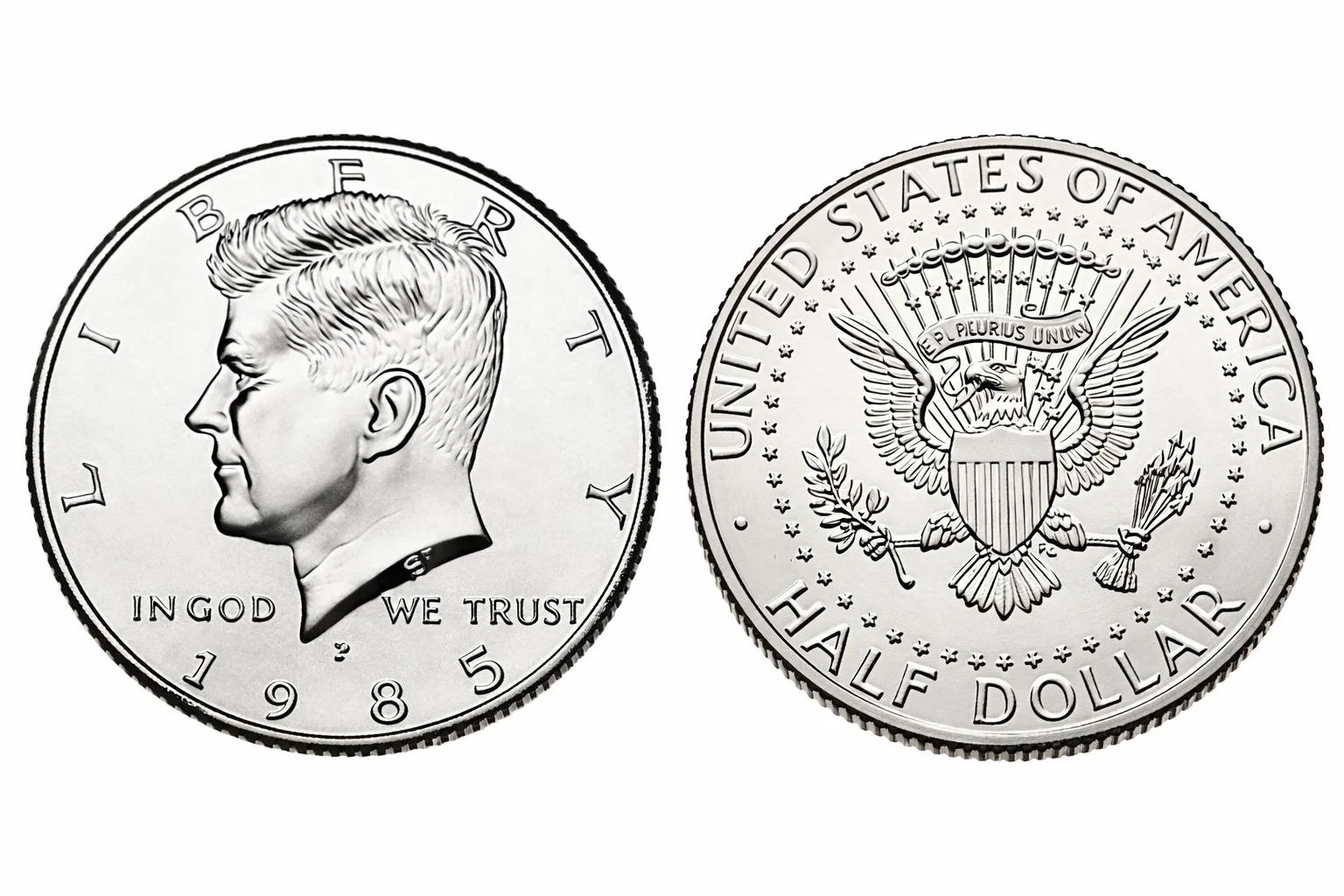
The Three Main 1985 Half Dollars
The 1985 year gives collectors three basic coins to sort.
| Type | Mint | Strike | Mintage |
| 1985-P | Philadelphia | Business Strike | 18,706,962 |
| 1985-D | Denver | Business Strike | 19,814,034 |
| 1985-S | San Francisco | Proof | 3,362,662 |
The Philadelphia and Denver coins were made for circulation. Both were struck in the high millions. PCGS calls both common issues. The San Francisco coin was made as a proof. It has mirror fields, collector handling, and a much lower mintage than the circulation strikes. That does not make it rare in absolute terms. It does place it in a separate market.
Quality Starts With Separation
A 1985 half dollar should be sorted in this order:
- Mint and strike type
- Circulated or uncirculated status
- Proof or business strike
- Surface quality
- Eye appeal
This order saves time. It also avoids the most common mistake: mixing a proof with a circulation strike and assuming the year alone explains the price. The year does not. The quality level does much more work.
Circulated Coins
Circulated 1985-P and 1985-D halves sit at the bottom of the value structure. They are modern clad coins with high mintages and strong survival. A 1985 Kennedy half dollar in circulated condition is worth about $0.60 to $0.75 as of March 2026. That gives a good starting point for both P and D business strikes.
The reason is simple. Wear removes the main source of collector interest for a modern common-date half. Once the surfaces are dull and the marks are obvious, the coin becomes a filler piece. It still belongs in a set. It just does not sit in a premium lane.
Typical Circulated Traits
- Wear on Kennedy’s hair and cheek
- Duller luster
- Scattered marks
- Little price spread between average pieces
This part of the market is flat. A collector can keep a circulated example for a date set, but the year does not become interesting until the coin moves into stronger quality.
Mint State Coins
Mint State is where the 1985 half dollar starts to split. The coin is still common in lower uncirculated grades. The market changes when quality rises.
PCGS says the 1985-P is scarce in MS66 and very difficult in MS67 or higher. The 1985-D is only scarce in MS67 or higher, while anything below that can be bought very inexpensively. These statements explain the real structure of the year better than a flat mintage discussion does.
The difference between an average Mint State coin and a stronger one is not abstract. On this date, the market looks closely at:
- Marks on Kennedy’s cheek
- Luster strength
- Field cleanliness
- Overall balance
- How few distractions the coin shows
That is why the Mint State market gets narrow at the top. The coin is common by mintage, but not every survivor is clean enough for higher-grade demand. An NGC Registry article from 2019 also highlights 1985-P in MS68 as a prized modern condition rarity, even though circulated pieces are worth only face-value-level money.
Proof Coins
The 1985-S proof is a different coin from the start. It was struck for collectors, not released into circulation, and preserved in much larger numbers than most business strikes of the year. PCGS lists the proof mintage at 3,362,662. The 1985-S proof has a broad range between $2.15 to $40.00, depending on the proof level.
Proof quality changes the conversation. A proof is judged by mirrored fields, frosted design, and surface preservation, not by circulation wear. The coin can still stay inexpensive in normal proof grades because many were saved well. The premium only grows when the grade gets sharper, and the surfaces stay clean.
Proof Strengths
- Mirror-like fields
- Stronger visual presentation
- Collector-only format
- Separate the market from the P and D business strikes
This is why a proof should never be placed in the same value paragraph as a circulated Philadelphia or Denver coin.
Value By Quality
The cleanest way to read the year is to compare quality lanes directly. The circulated range below comes from NGC. The Mint State and proof ranges below come from current Greysheet listings for the 1985 Kennedy half dollar series.
| Type | Circulated | Mint State | Proof |
| 1985-P | $0.60–$0.75 | $0.50–$3,000 | — |
| 1985-D | $0.60–$0.75 | $0.50–$2,250 | — |
| 1985-S | — | — | $2.15–$40.00 |
The ranges are wide for a reason. Lower-end Mint State coins remain common. Top-end coins do not. The proof range is much narrower because preservation is stronger across the board.
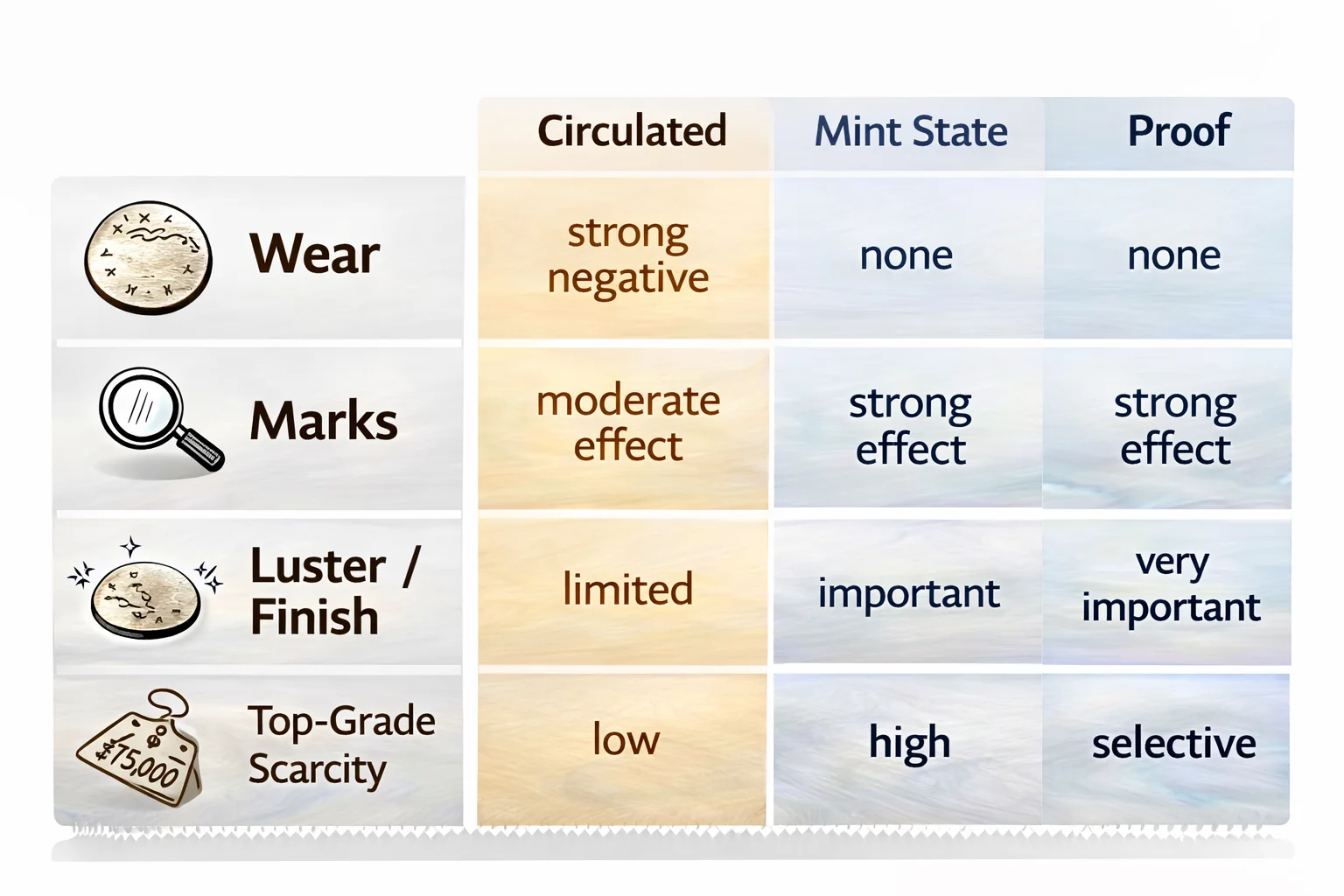
What Changes Value Most
The year itself is not the main driver. These factors matter more:
| Factor | Circulated | Mint State | Proof |
| Wear | strong negative | none | none |
| Marks | moderate effect | strong effect | strong effect |
| Luster / Finish | limited | important | very important |
| Top Grade Scarcity | low | high | selective |
This is the real structure of the 1985 half dollar market. Circulated pieces are flat. Mint State pieces spread out sharply at the top. Proof coins stay affordable until the highest grades begin to matter.
What New Collectors Often Get Wrong
The first mistake is treating all 1985 halves as one price group. The second is assuming that “uncirculated” always means premium. The third is mixing proof and business strikes in the same mental bucket.
Common Mistakes
- Comparing 1985-S proof to worn P and D coins
- Calling every bright coin Mint State
- Ignoring marks on the cheek and fields
- Checking the date before the quality
A better method is simple. Separate the type first. Then decide if the coin is circulated, Mint State, or proof. Only after that should price enter the discussion.
What To Check Before You Judge Price
This is the practical part.
First Review Checklist
- Is it 1985-P, 1985-D, or 1985-S?
- Is it circulated, Mint State, or proof?
- Are the surfaces average or better?
- Does the coin show strong eye appeal?
- Is the price based on quality or just the date?
A coin identifier app can help at this stage. The best use is not final pricing. The best use is sorting. It helps separate P, D, and S issues quickly before closer inspection starts. That is useful for new collectors, inherited lots, and mixed Kennedy groups where proofs and business strikes sit together.
Which Version Fits Which Collector
Different quality levels serve different goals.
| Collector Goal | Best Fit |
| low-cost date example | circulated |
| better regular issue | Mint State |
| collector-only format | proof |
That is the cleanest summary of the year. A circulated coin fills the date slot. A stronger Mint State coin gives the year more interest. A proof gives the sharpest presentation but stays in a separate collector lane.
Conclusion
The 1985 half-dollar is not a date-first coin. It is a quality-first coin. Circulated pieces stay low. Mint State coins split sharply at the upper end. Proof coins form their own market from the start. That is the right way to read the year.Try the coin value app to sort the coins before a deeper manual review. Coin ID Scanner fits that first-stage role well. It can organize coins through saved coin cards, help with quick sorting, and support collection management when circulated, Mint State, and proof examples need to be kept apart. The final decision still depends on the coin in hand.